
An essay by Rron Thaci, Consumer & Culture
Creative Due Diligence
A framework for underwriting brand
Substack version5 min readPublished Sep 2026
Brand is one of the stranger parts of diligence.
Everyone is evaluating it, but we rarely use the same language when we do. A “strong brand” can mean good creative, a recognizable founder, an engaged audience, great packaging, cultural relevance, or simply a product people seem excited about.
Those things matter, but they aren’t interchangeable.
That’s what led me to build Creative Due Diligence, a framework for looking at the qualitative side of a business with a little more structure.
The idea isn’t to replace financial diligence or turn taste into a formula. It’s to make the parts of the brand we’re already reacting to more explicit, particularly in consumer businesses where creative signals can show up well before their full impact is visible in the P&L.
A brand can look culturally strong long before we know whether it has durable pricing power. Community can form before we have enough cohorts to understand retention. Distinctive positioning can make organic acquisition easier before there’s enough scale to prove a structural CAC (Customer Acquisition Cost) advantage.
Those signals aren’t substitutes for the economics. They’re often early indicators of where the economics could go.
Brand has to do something
I’ve become less interested in whether a brand is simply “good” and more interested in what the brand is doing for the company.
Ultimately, strong brand equity should make some part of the business easier.
CAC cost is one of the clearest places to see it. If the market already knows who you are, customers are looking for you by name, people are sharing the product organically, and a portion of your demand comes without having to pay for every impression, customer acquisition should become more efficient over time.
That doesn’t mean low CAC automatically equals great brand. Distribution, category dynamics, pricing, channel mix, and plenty of other things influence it. But if a company claims to have exceptional brand strength and still needs to continually rent its audience through paid media, I want to understand the disconnect.
The same logic applies elsewhere.
Strong brand can support repeat purchase and retention. It can increase LTV (Lifetime Value). It can give a company room to price at a premium, improve retail velocity, create better inbound partnership opportunities, or make it easier to launch the next product into an audience that already cares.
There doesn’t need to be one universal KPI.
There does need to be some translation from brand strength into business performance.
That commercial link is what separates an attractive brand from an actual business asset.
The five dimensions
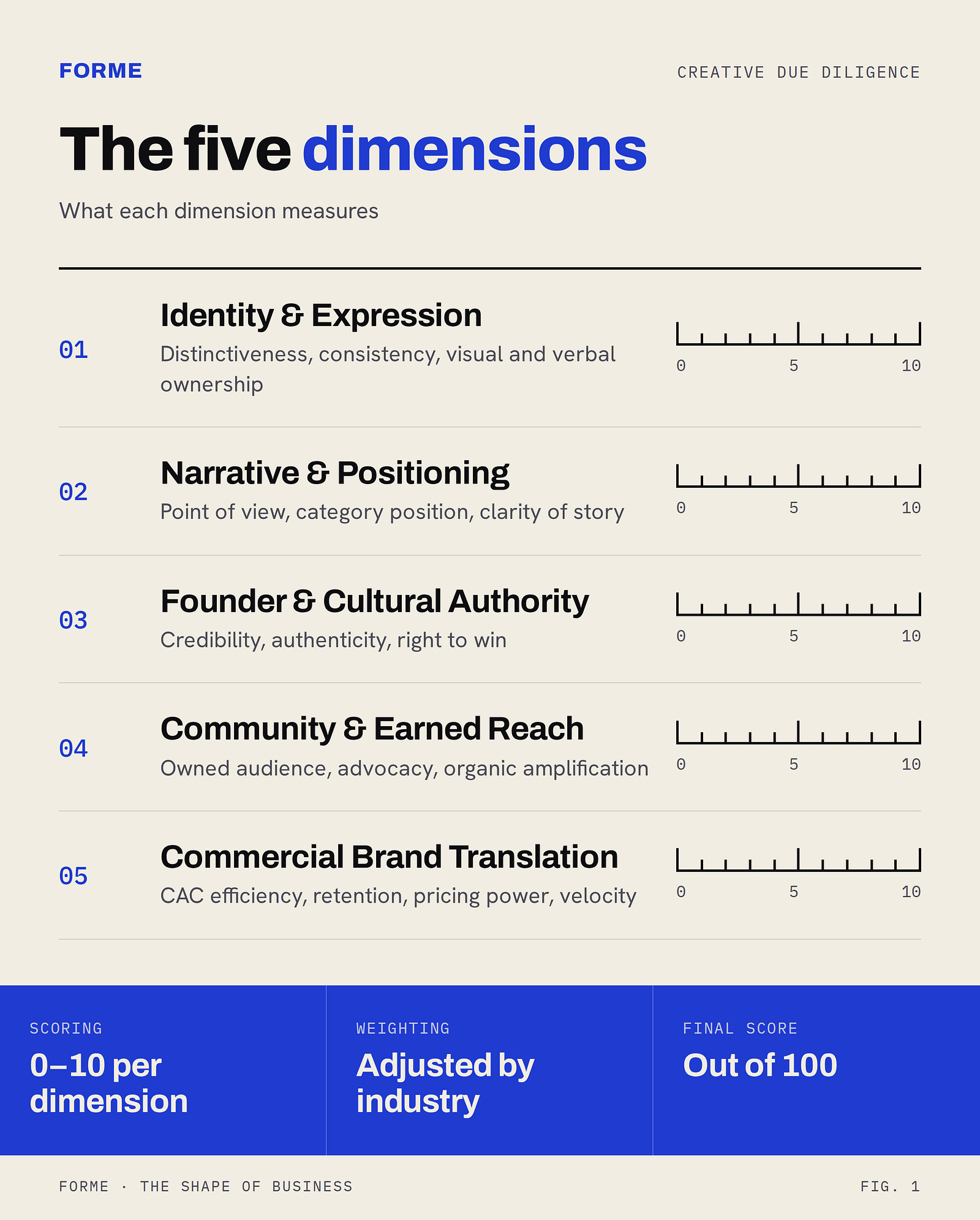
Creative Due Diligence breaks brand into five dimensions. Each is scored from 0–10 and then weighted by industry.
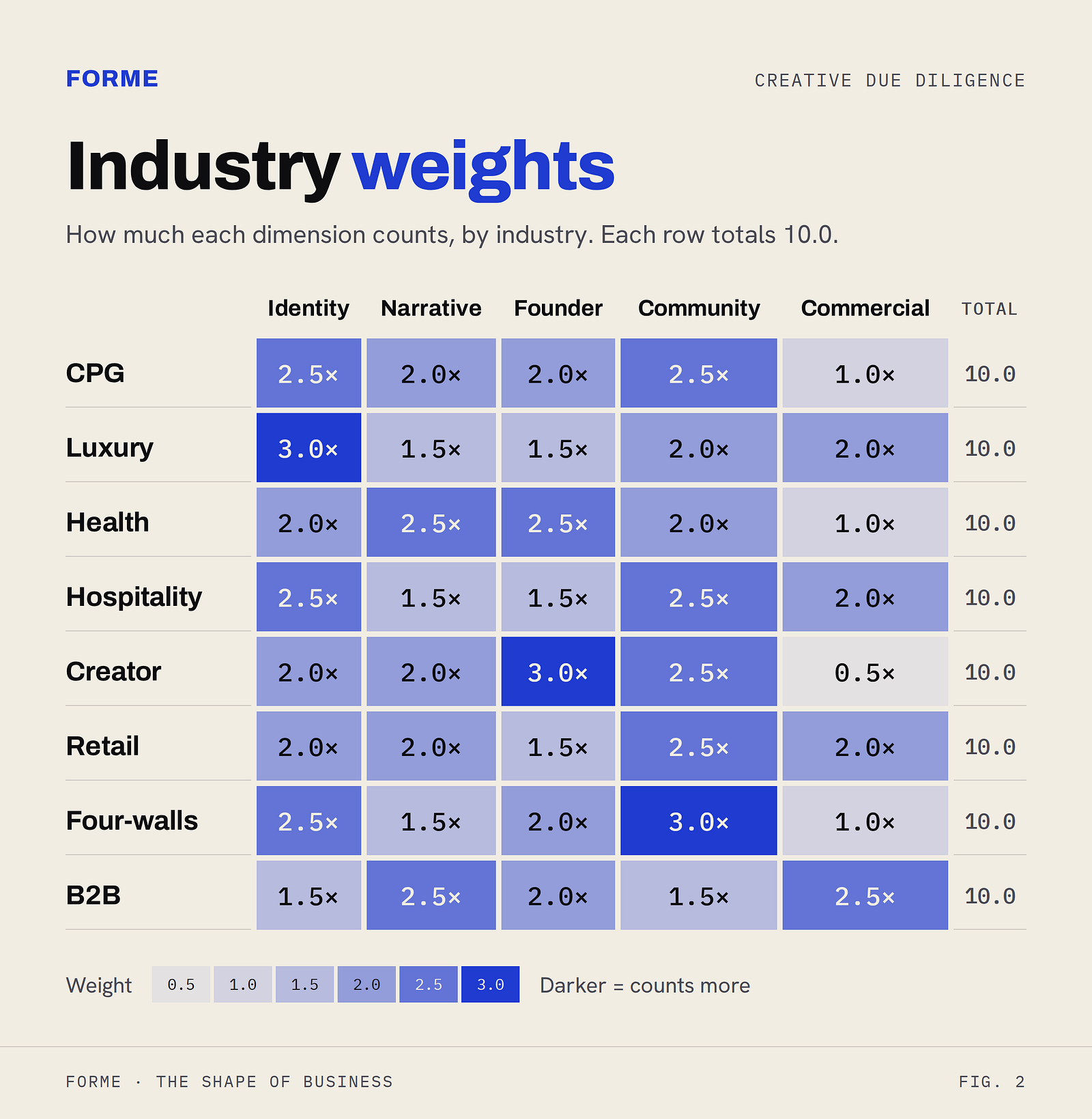
The weighting matters because brand doesn’t play the same role in every business. Identity can be existential for a luxury company and much less important to a B2B software business. Founder authority can matter disproportionately in creator-led companies or health. Community might be central to a four-walls concept while playing a smaller role in an enterprise sales process.
The framework keeps the dimensions consistent while changing their relative importance.
01 — Identity & Expression
The visual and verbal language the company owns.
This includes design, packaging, typography, tone, digital presence, and the consistency of how the brand shows up. I’m less interested in whether it looks good than whether it looks recognizably like itself.
A beautifully designed brand that looks like the rest of its category can still be weak here.
02 — Narrative & Positioning
The idea the company owns in the customer’s mind.
This is about whether the brand has a clear point of view and occupies a position that competitors can’t easily copy with different creative.
Strong positioning makes the company easier to understand and easier to remember.
03 — Founder & Cultural Authority
The credibility of the people behind the company.
In some categories, customers care deeply about whether the founder actually belongs in the world they’re building for. Domain experience, personal connection to the problem, cultural credibility, and public trust can all become real brand assets.
04 — Community & Earned Reach
The audience the brand has earned rather than rented.
Follower count isn’t enough. I’m more interested in whether people advocate for the company, return without being reminded, create their own conversations around it, and bring others in.
Paid reach disappears when the spend stops. Earned reach has the potential to compound.
05 — Commercial Brand Translation
The point where the brand begins to show up in the business.
CAC efficiency, repeat purchase, retention, pricing power, retail velocity, stronger inbound, and the quality of distribution can all sit here.
This dimension keeps the framework honest. Brand that never creates a commercial advantage is still creative work, but it’s harder to call it a moat.
The Creative Due Diligence model
The weight matters more than the average
A consumer packaged goods company and a B2B software company shouldn’t be judged with the same brand model.
Here’s how I currently weight the dimensions:
The score can be useful when underwriting a deal, comparing companies, or helping an operator understand where the brand is exposed.
But I don’t think the total is the most useful output.
The shape of the score usually tells you more.
A company can be exceptional on identity and narrative but weak on community. Another can have a highly engaged audience while depending almost entirely on the founder for its authority. A third can look strong everywhere creatively but show very little commercial translation.
All three might end up with a similar headline score.
They’re not the same investment, and they don’t need the same work.
That’s why the gap between the strongest and weakest dimensions is often the most useful part of the framework.
Making qualitative judgment more disciplined
Creative Due Diligence isn’t an attempt to make brand objective.
I don’t think it is.
The goal is to make qualitative judgment more disciplined.
Taste still matters. Pattern recognition matters. Understanding culture matters. But investors and operators should be able to explain what they’re reacting to beyond saying that something feels like a great brand.
The framework gives those reactions some structure and ties them back to the economics of the business.
A strong identity should create recognition. Strong positioning should improve recall. Community should create organic distribution and retention. Eventually, those advantages should show up somewhere in CAC, LTV, pricing, velocity, repeat behavior, or the ability to expand.
That’s where creative diligence meets traditional diligence.
Not by replacing the model, but by helping explain some of the things that may eventually move it.
Creative Due Diligence
Score a brand across the five dimensions, choose the relevant industry weighting, and use the resulting profile to identify where the brand is strongest and where the underlying risk sits.
The total is useful. The gap is the brief.
If you want to try out the scorecard, click on the button below.
Share
Next essay
