

An essay by Rron Thaci, Consumer & Culture
The Limits of Efficiency
We’re getting better at making businesses efficient. I’m less convinced we’re getting equally good at using that efficiency.
Substack version5 min readPublished Oct 2026
Convenience might be one of the greatest innovations of the past few decades.
We can order groceries without leaving the house, book a restaurant in seconds, check into a hotel from our phones, and get answers to questions that once required a call, a visit, or a fair amount of patience. Entire businesses have been built around making everyday life easier, and most of us are considerably better off because of it.
I think about this whenever I have to call customer support. There’s almost nothing more frustrating than spending twenty minutes navigating an automated system, explaining the same problem three times, and still not reaching someone who can help. On the other hand, when a capable person answers within two minutes and actually understands what I’m asking, my opinion of that company improves immediately.
Both businesses might tell you they’ve invested heavily in efficiency. One has reduced the number of calls handled by employees. The other has made it easier for customers to get their problems solved. Those aren’t necessarily the same achievement.
This probably sounds obvious. Of course businesses should care about their customers. We’ve been talking about customer experience for decades. But we keep getting better at saving time and money without necessarily getting better at deciding what to do with those savings.
And with AI making more routine work easier to automate, I think that decision is only becoming more important.
When Convenience Stops Mattering
Think about making a dinner reservation.
Not long ago, you had to call during business hours, wait for someone to pick up, and hope there was a table available. Today, you can do the whole thing in thirty seconds.
That’s a huge improvement. But reducing those thirty seconds to twenty doesn’t offer nearly the same benefit. Get it down to ten, and I’m not sure anyone is choosing that restaurant over another because of it.
At some point, the process is easy enough. The things that matter now are the food, atmosphere, service, and whether you actually enjoy being there.
This is where convenience starts to experience diminishing returns. The first improvements can change an experience entirely, while each additional improvement becomes less noticeable.
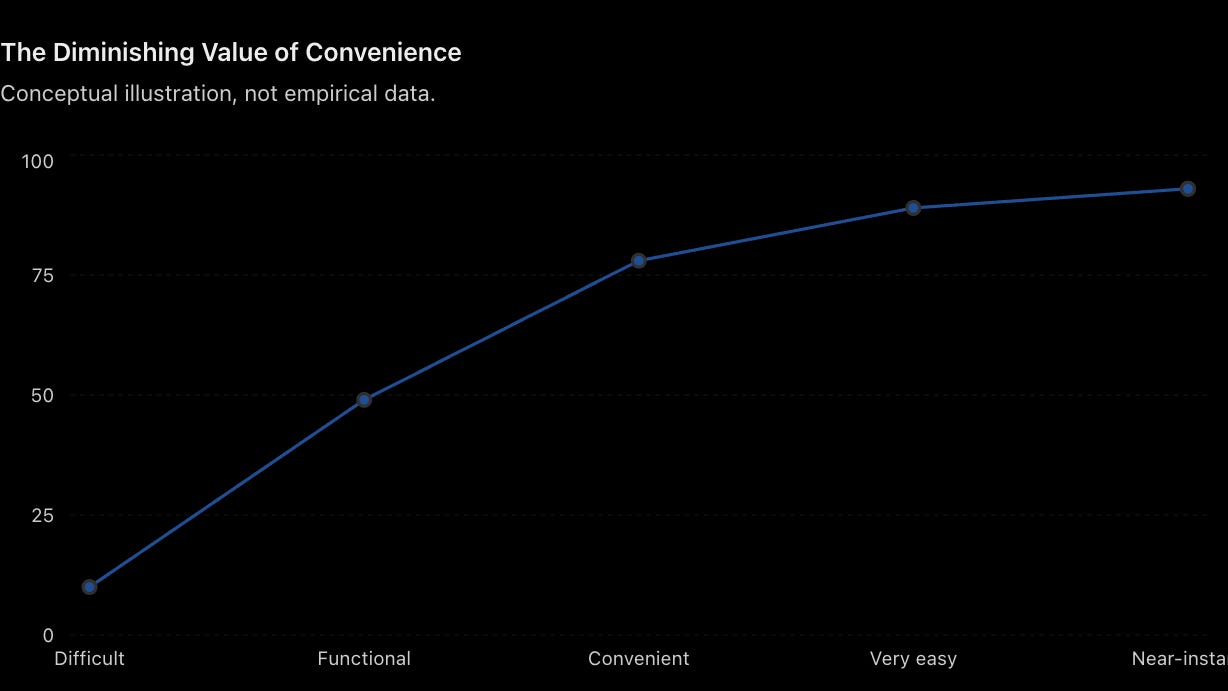
The same principle applies to plenty of businesses. Reducing a customer’s wait from thirty minutes to five is meaningful. Reducing it from five to three probably isn’t.
That doesn’t mean the second improvement has no value. It might still reduce costs, save employees time, or make the operation more reliable. But the benefit to the business and the benefit to the customer aren’t always the same.
The interesting part is what happens once we’ve made the process efficient.
The Temptation of Doing More
I spend a lot of time looking at tech companies, and much of the excitement around AI comes from how much routine work it could make easier. Scheduling, reporting, customer support, forecasting, and administrative tasks can all become less time-consuming.
Those improvements are worth pursuing. But saving time is only the first decision. The second is figuring out where that time should go.
If a restaurant uses better software to save its servers five minutes of work every hour. Over a five-hour shift, that’s twenty-five minutes.
The obvious choice might be to increase the number of tables each server handles. More customers, roughly the same labor costs, potentially better margins. Especially in a business with tight margins, that’s a perfectly reasonable decision.
But what if the server kept the same number of tables?
Those extra minutes could go toward making better recommendations, checking in once more, or simply giving guests a little more attention. The restaurant still benefits from the efficiency gain, but it uses that time to improve the experience rather than increase capacity.
Of course, maybe the restaurant needs another table to make its economics work. Maybe customers would rather pay less for a quicker meal. There isn’t a universal answer.
The more interesting question is whether the business has considered both options, or simply assumed that serving more people is the natural next step.
And this isn’t limited to hospitality.
In B2B Saas a customer success team might handle 70 accounts. After introducing better automation, the company realizes those managers could reasonably handle 100.
On paper, that’s a significant productivity improvement.
One option is to increase account coverage without adding headcount. Another is to keep the managers at 70 accounts and use the extra time to improve onboarding, help customers adopt more of the product, and get ahead of problems before renewals.
Imagine that six months later, the team handling 100 accounts has better productivity numbers, but the team handling 70 has lower churn and stronger expansion revenue.
Which one used the technology better?
You’d have to look at the actual dollars. If the retention and expansion gains outweigh the additional revenue from covering more accounts, the supposedly less productive team may have created more value. If the differences are small, increasing coverage could be the better decision.
Both teams became more efficient. What changed was how they chose to use the time.
What Are We Actually Building?
I think this is where a company’s ambition starts to matter.
Some businesses need to win on price and volume. Others compete on quality, service, or customer relationships. A fast-growing startup trying to capture market share has different pressures from a neighborhood restaurant that wants to make the best burger in town.
Neither is inherently better, and neither is an excuse to ignore the economics.
I’ve always appreciated businesses that know exactly what they’re trying to deliver and resist changing that promise every time there’s an opportunity to extract a little more revenue. The neighborhood spot that keeps its prices reasonable and makes an incredible product is an easy example. At a much larger scale, Costco’s long-standing $1.50 hot dog and soda combo reflects a similar commitment to being associated with value.

That doesn’t mean keeping prices low is always the right decision. Sometimes you need higher margins to pay employees properly, maintain quality, or stay open. And sometimes increasing volume makes a good product accessible to more people.
The point is that the right use of an efficiency gain depends on what you’re trying to build and why customers choose you in the first place.
There’s also something worth watching as technology becomes more widely available. If every restaurant has good scheduling software and every software company can automate routine customer support, those improvements may raise the standard across an entire industry without giving any individual business much of an advantage.
What businesses choose to do with the time they save might become more important than the tools that saved it.
We’ve spent decades improving how much work businesses can get done with the same resources. AI will likely accelerate that progress, and there’s plenty to be excited about.
But more capacity, lower costs, better service, and stronger customer relationships are different outcomes. They deserve different decisions, even when they begin with the same efficiency gain.
The best use of an extra five minutes isn’t necessarily another table, another account, or another transaction.
Sometimes it’s making the original one worth coming back for.
The question isn’t just how much time we saved. It’s what that time is worth once we decide where to spend it.
Share
Next essay