

An essay by Rron Thaci, Technology & Investing
The Next Vertical Software Moat
Thoughts on data, vertical software, and where we think real disruption comes from.
Substack version7 min readPublished Sep 2026
A while back, I wrote a piece called The Data Gap Is Dead. The basic argument was that data itself was becoming less scarce, and that simply having more of it wasn’t necessarily the moat people made it out to be.
I still believe that. If anything, watching the startup market over the last year has made me more skeptical of the generic data moat.
Almost every company is collecting proprietary data now. Every workflow product creates some form of it naturally, and with AI involved, the pitch tends to become familiar pretty quickly: we own this unique dataset, our models get better as it compounds, and therefore the business gets more defensible over time.
Sometimes that’s true. I just don’t think it’s automatically true.
If I have 93% of the useful market data and you have 97%, that extra 4% may not change a single decision. At some point, having more of an already observable dataset starts to hit diminishing returns.
What I’ve become more interested in are companies that create new data layers inside the physical world—information that wasn’t sitting neatly in another database waiting to be aggregated, but information that effectively didn’t exist in a usable form until somebody figured out how to capture it.
I think there’s a meaningful difference between collecting more data and making something observable for the first time.
Vertical software is getting easier to build
For a long time, going deep into an overlooked industry was enough to create a pretty compelling software opportunity.
Find a vertical running on spreadsheets and legacy software, understand the workflow better than a horizontal software company could, and build specifically for it. Dental offices, HVAC contractors, restaurants, fishing fleets, lumber mills and thousands of other niches all became potential software markets.
I don’t think that opportunity disappears, but the advantage is getting smaller.
Software is getting easier, faster and cheaper to build. AI is accelerating that. A good interface matters, integrations matter, and deep workflow knowledge still matters, but simply being “the software built for this niche” feels less defensible than it did before.
The data generated through that software has the same problem. A dental practice management system will naturally capture appointments, procedures, payments, customer communication and scheduling information. That’s useful, but another good dental software company should eventually be able to collect most of the same things.
I’ve been more interested in the layer underneath that: parts of a physical industry that still aren’t digitally visible at all.
Barge logistics is an example I’ve come across recently.
Commercial towing vessels already use AIS systems that can broadcast things like location, identity, course and speed. But the U.S. Coast Guard’s AIS rules apply differently to towing vessels and non-self-propelled vessels, and broadcasts from AIS Class A or B devices on non-self-propelled vessels are prohibited.
That means knowing where the towboat is doesn’t necessarily give you a clean digital identity for every individual barge in the tow, what’s happening with it commercially, where it’s ultimately headed, or every handoff and delay that matters downstream.
Some of that information exists, of course. It might live with an operator, in an email, over a radio, inside another system or through a phone call. The point is that it isn’t necessarily being created as a consistent, market-wide digital record.
A startup can attack that in ways that might initially look pretty ugly. Maybe it’s cameras at certain points along the river. Maybe it’s new hardware. Maybe it’s stitching together several existing sources. Maybe, at first, it’s literally calling people and putting the information into a database.
That’s where I think startups have an interesting advantage.
The incumbent barge operator’s job is to move freight. It has spent decades figuring out how to operate despite imperfect information. Calling every participant in the industry, installing cameras, building a new identification system or manually cleaning data isn’t necessarily a good use of its time.
For a startup, that can be the entire job.
Sometimes the manual part is how the asset gets created
Timber has a similar dynamic.
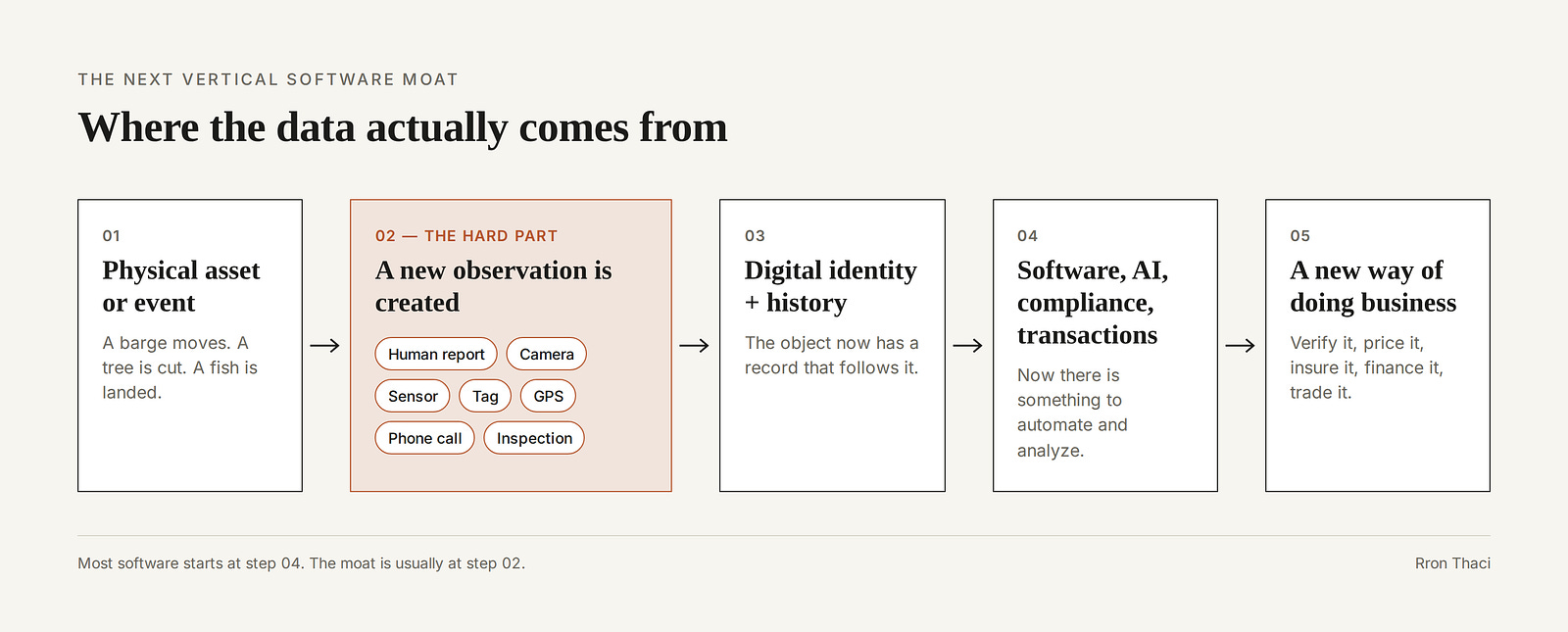
A tree or log can have all kinds of economically useful information attached to it: origin, species, dimensions, quality, when it was harvested, who handled it, where it went next and what it eventually became.
But cutting down a tree doesn’t automatically create a digital record.

Somebody has to create the identity, connect the physical object to it and continue recording information as it moves through the supply chain.
That could happen through RFID, cameras, sensors, scans or simply manual entry. I’m less interested in which technology wins than in the fact that someone has to create the observation in the first place.
Software people naturally want to automate the first step as quickly as possible. Eventually that makes sense.
But I don’t think starting manually is necessarily a weakness. Calling 100 operators every week isn’t scalable. Neither is manually tagging assets or reviewing thousands of hours of footage. But doing the work yourself can show you which information actually matters, how reliable it needs to be, who cares about it and, most importantly, whether creating it changes anything.
That’s the part I think matters most.
Some data should probably stay dead
Creating a new dataset isn’t valuable just because the dataset didn’t exist before.
There are plenty of things in the physical world we could measure more precisely without changing the underlying economics of the business.
Maybe a company finds a clever way to track some previously invisible part of an operation. If the result is a slightly better dashboard and nobody changes a meaningful decision because of it, that data probably isn’t as valuable as it sounds.
This is where I think the 93% versus 97% idea becomes useful.
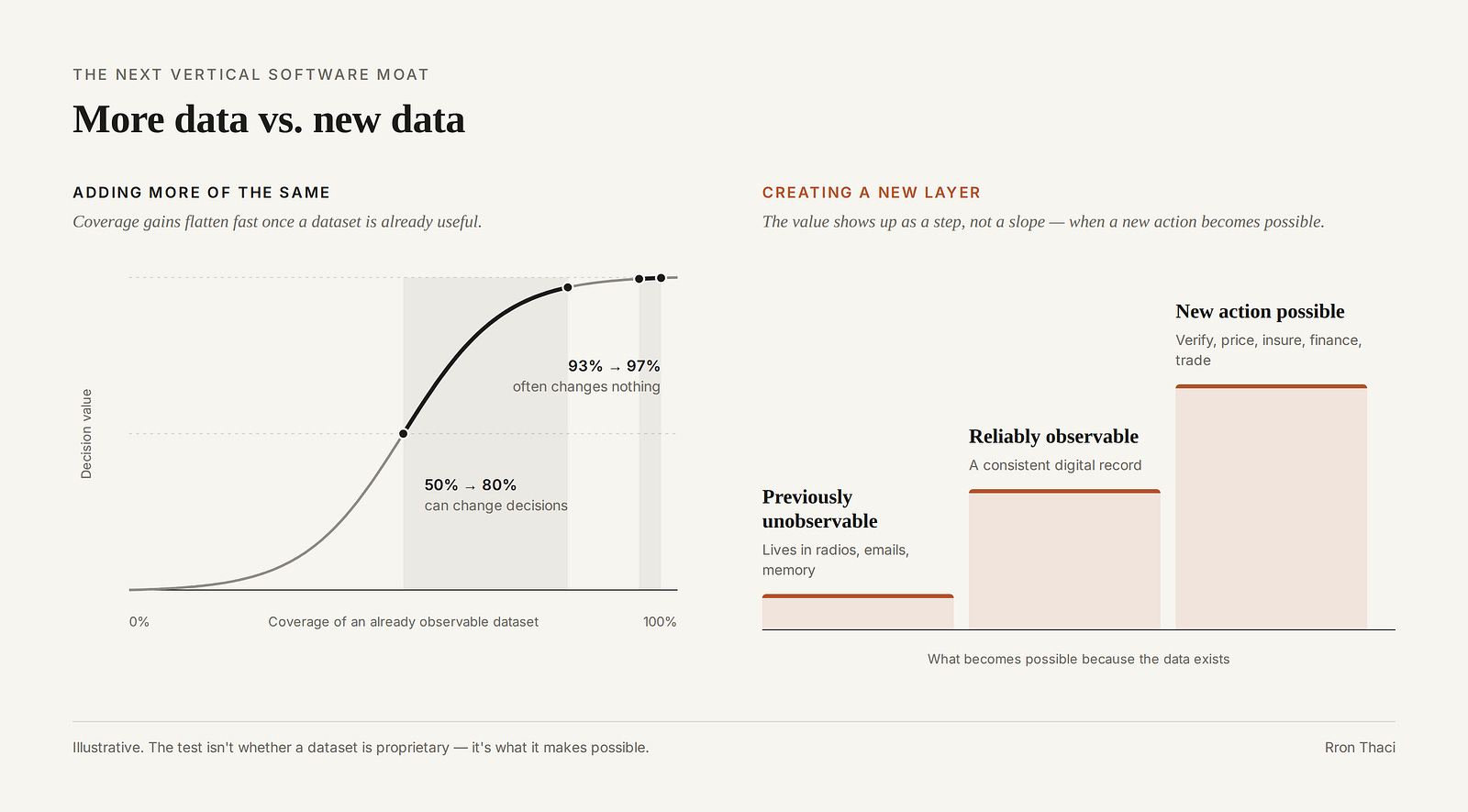
The real test isn’t whether the dataset is proprietary. It’s what becomes possible because it exists.
Sometimes the outcome is pretty straightforward. Better barge visibility might reduce waiting time, improve scheduling or let terminals plan capacity more efficiently. That’s real value even if nothing else changes.
Regulation can make the value much more obvious. The EU’s deforestation regulation, for example, covers wood and requires companies bringing covered products into the EU market to demonstrate that they meet deforestation and legal-production requirements. The rules begin applying to large and medium operators on December 30, 2026.
All of a sudden, knowing the origin and history of timber isn’t only operationally useful. Traceability can become part of someone’s ability to participate in a market.
Fishing gives us another version. Fisheries have historically relied on human observers, vessel monitoring systems, logbooks and other reporting methods to understand what happens at sea. NOAA is increasingly using cameras, GPS and gear sensors through electronic monitoring to capture fishing location, effort, catch and discards, with that data also supporting regulatory compliance.
The interesting part isn’t that cameras are replacing paper. It’s that activity that was historically difficult to observe can become consistently measurable.
Once that happens, the impact can go beyond efficiency or compliance.
The real disruption is what happens next
I think this is the third step I’ve been missing when thinking about these companies.
A new data layer becomes really interesting when it changes the economics of the industry around it.
Once an asset or activity has a reliable digital identity and history, you can start doing things that were previously difficult or impossible. You can verify it, price it differently, insure it differently, finance it, build a marketplace around it, create a new underwriting process or change the way buyers and sellers find each other.
A timber dataset might start by helping someone track wood through a supply chain. If that information eventually makes quality, origin and inventory more transparent, maybe it changes how mills source timber. Maybe it enables a better marketplace. Maybe lenders can underwrite timber assets differently. Maybe developers acquire land differently because the quality and quantity of the underlying resource can be understood earlier.
Not every new dataset gets there. Most probably don’t.
But that’s increasingly the distinction I’m looking for in startups.
The weaker version is: we collect data nobody else has.
The more interesting version is: because we created this data, people can now do something they couldn’t do before.
Sometimes that’s just a materially more efficient workflow, and that’s enough. Sometimes regulation creates the reason the data suddenly matters. But the really compelling cases can create a new transaction, a new market or eventually a new standard for how the industry operates.
That’s what I’d call disruption.
Bringing an industry online
So I don’t think bringing an offline industry online simply means replacing spreadsheets with software.
Most industries already have plenty of software.
It means finding the parts of the physical world that still aren’t visible digitally, finding a practical way to observe them and then seeing whether making them visible changes the way the industry works.
AI will obviously play a role in that. Once the data exists, models can interpret it, automate decisions around it and find patterns that people wouldn’t find manually.
But AI still needs something to observe.
And with everyone chasing proprietary datasets right now, I think it’s worth separating companies that accumulate more of the same data from companies that are actually expanding what can be known.
The first creates a larger database.
The second can create a new way of doing business.
Share
Next essay