An essay by Rron Thaci, The Business of…
The Business of the Souvenir
How experiences turn into memory, loyalty, and demand
Substack version5 min readPublished Sep 2026
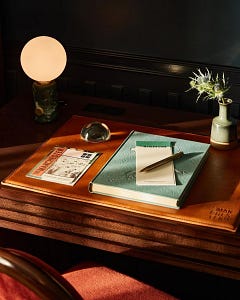
I have a notepad from The Manchester sitting on my coffee table.
I don’t need it. I already have a notebook I use every day, and I don’t plan on writing anything in this one. I kept it because I liked the hotel, the notepad looked good, and after a great stay it somehow felt worth taking home.
I’ve started doing this more often. When I stay somewhere I really like or have an experience that sticks with me, I’ll find something small to keep.
It made me realize that a souvenir is doing something fairly specific. It’s bridging an intangible experience into something physical. The experience eventually ends, but you leave with proof of it, something you can carry forward.
And in some cases, the fact that you want to carry something forward says quite a bit about the business that created the experience.
Something to carry forward
Most souvenirs aren’t particularly valuable on their own.
A hotel notepad is still a hotel notepad. Packaging is usually meant to be thrown away. The object doesn’t suddenly become more functional because you had a good time.
It inherits value from what happened around it.
A 2025 consumer study, The Materialization of Experiences, found that people who perceived an experience as deeper or more meaningful were more likely to prefer a unique object associated with it. The researchers also found that part of the appeal came from the object’s conversational value: it gave people something through which they could continue talking about the experience.
That gets closer to what makes certain souvenirs stick.
Price helps in some cases. Higher-end businesses generally have more room to invest in materials, packaging, design, and the small physical details surrounding the core product. But price isn’t really the point. Something expensive can still be forgettable, while an inexpensive object tied to a great experience can stay around for years.
The souvenir doesn’t have to be expensive. It has to feel undeserving of the trash.
The quality of the object matters, but it can’t outrun the quality of what it represents.
Another 2025 study on mementos, Of Photographs, Souvenirs, and Ticket Stubs, found that people’s desire to preserve an experience tends to increase as the experience approaches its end, particularly when it isn’t easily repeatable. There’s something intuitive about that. Once you know a good experience is temporary, having an object attached to it gives the experience somewhere to go.
That’s what I think of as a memory dividend.
The stay happens once. The dinner happens once. The trip ends. But the object can continue producing small moments of recall long afterward.
You see it again. Someone else notices it. The memory comes back. Sometimes it turns into a recommendation or another visit. Sometimes it simply keeps the place unusually present in your mind.
The original transaction ended a long time ago, but some value from it is still being paid out.
What keeping it tells the business
There’s another side to this that I think is more interesting than simply calling souvenirs “good branding.”
Keeping something is a behavior.
A purchase tells a company that the customer wanted what it was selling. Preservation tells you the customer found value in something beyond the core transaction.
A souvenir can be evidence that an experience created more value than could be consumed in the moment. The customer wants to preserve some of the excess.
That can help identify a different kind of customer.
There’s a meaningful difference between customers who like the product and customers who want to participate in the world around the product. The latter group may be more likely to return, recommend it, buy adjacent products, show up for a collaboration, or pay for something that isn’t part of the original offering.
In other words, souvenir behavior can reveal surplus demand around the core business.
I like the idea of a loose keep rate here. Not something I expect to see on a company dashboard, but a useful mental model.
Most businesses optimize for purchase. Some can create a second behavior -preservation.
What gets kept, reused, displayed, photographed, or collected can reveal things a normal transaction doesn’t. It gives the business another signal about which parts of its identity, aesthetic, experience, or customer relationship have enough resonance to survive outside the original context.
A business could learn quite a bit from three things:
- What gets kept — which artifacts actually earn a place in the customer’s life.
- Who keeps it — the customer segment with attachment beyond pure utility.
- What happens next — whether that attachment turns into repeat behavior, recommendations, collecting, or demand for something new.
That last one can eventually create another layer of the business.
Something that starts as a complimentary artifact can become merchandise. Merchandise can become a real product category. A recognizable object can become the basis for limited releases or collaborations.
That isn’t the same thing as taking a logo and putting it on more stuff.
The customer has already shown the company that they want more of its world than the core product gives them.
For a business, that attachment can eventually show up in a few places that matter: stronger repeat behavior, more organic word of mouth, a customer who is easier to bring back, and demand for products beyond the original transaction. In the best cases, the artifact itself becomes another revenue layer through merchandise, limited releases, collaborations, or adjacent products. The souvenir isn’t creating those economics on its own, but the willingness to keep it can be an early signal that the customer relationship is deeper than the purchase.
Beyond consumer
This behavior is easiest to see in consumer businesses. Hospitality, retail, fashion, travel, and events naturally produce experiences with physical things attached to them.
But I don’t think the underlying idea is limited to consumers.
Services and B2B businesses create intangible experiences too. A project gets finished, a deal closes, a partnership launches, and eventually most of the relationship gets reduced to email threads and documents sitting in a drive.
A physical artifact connected to something that actually happened between two sides can make the relationship more tangible.
The distinction matters here. Generic corporate swag is usually asking the recipient to remember the company. An object tied to a shared experience gives them a reason to.
In that context, the business value is less traditional brand awareness and more relationship memory. For businesses where repeat work, referrals, introductions, and future deals matter, being unusually easy to remember has value.
That’s probably the broader lesson in souvenirs.
Businesses spend a lot of time designing the moment: the product, the space, the service, the transaction. There’s less attention paid to what survives once the moment is over.
The best souvenirs aren’t reminders a company forces on its customers.
They’re objects customers decide are worth carrying forward.
Swag says: remember us. A souvenir says: I want to remember this.
The experience gives the object meaning, and the object gives the experience somewhere to live.
Share
Next essay